
The Indian Air Force (IAF) has spent much of the past several decades dealing with familiar questions: the size and composition of its combat fleet, modernisation of ageing platforms, induction of new aircraft, availability of weapons, and the persistent challenge of maintaining an adequate force structure in the face of competing demands. These remain important questions. But they no longer define the future of Indian air power.
The more consequential question is how the IAF will transform itself for a battlespace in which technology changes faster than traditional military acquisition cycles, the distinction between air and other domains is increasingly blurred, and relatively inexpensive unmanned systems can impose disproportionate costs on sophisticated platforms.
The answer cannot be reduced to the number or generation of combat aircraft in the inventory. The wars of the future will be fought in an increasingly transparent, contested and networked battlespace in which air power will have to contend simultaneously with long-range precision weapons, autonomous systems, massed drones, electronic and cyber warfare, space-based surveillance, increasingly sophisticated air defences and attacks on the very infrastructure that sustains combat operations.
The implication is consequential. The IAF’s future challenge is not simply to modernise its existing force structure, but to transform how it generates combat power.
Changing Character of Air Warfare
Two characteristics are defining future warfare. First, the compression of the sensor-to-shooter cycle; second, the proliferation of capabilities that can challenge the advantages of advanced air forces.
The emergence of inexpensive unmanned systems is particularly significant. The operational use of drones and loitering munitions in recent conflicts has demonstrated that relatively low-cost systems can perform surveillance, targeting, electronic warfare and strike missions while imposing disproportionate demands on conventional air defence.
At the other end of the spectrum are increasingly sophisticated integrated air-defence systems, long-range missiles, passive sensors and electronic warfare capabilities designed to deny or degrade the employment of high-value aircraft.
Air forces will have to find targets in an environment in which adversaries actively conceal, deceive and disrupt. They will have to generate combat sorties while their bases and communications infrastructure are under attack. They will have to operate when the electromagnetic spectrum is contested and when access to individual sensors or networks cannot be assumed. The concept of Air superiority will increasingly be less about controlling the air through fighter performance alone and more about controlling the adversary’s ability to sense, decide, and engage while preserving one’s own ability to do the same.
From Platforms to Combat Ecosystems
Platforms have heavily influenced traditional measures of air power: how many fighters, what type of aircraft, how many missiles, how much airlift, or how many airborne early-warning aircraft. The traditional platform remains an important unit of military capability because aircraft determine range, payload, persistence and survivability. Yet the platform is increasingly becoming one component of a larger combat system.
Future air warfare is unlikely to be determined by the performance of an individual fighter aircraft alone. It will depend on the ability to connect sensors, weapons, platforms, data, artificial intelligence, electronic warfare, space-based capabilities and command-and-control systems into a coherent combat architecture. This suggests a fundamental change in how the IAF should conceptualise force development. The IAF will therefore need to move progressively from a platform-centric conception of air power towards an adaptive and networked conception of aerospace power.
This isn’t a completely new approach since the IAF has already shown an interest in unmanned systems, swarm technologies, artificial intelligence, and manned-unmanned teaming. The challenge now is to turn these initiatives into a broader force transformation.
Technology Absorption Cycles
In the future, the ability to absorb technology will matter more than the ability to acquire it. A country can purchase a sophisticated aircraft and operate it effectively. But genuine technological advantage comes from the ability to understand, integrate, modify, upgrade and eventually replace the technologies on which that capability depends.
Traditional acquisition cycles are designed around major weapons platforms whose development and service lives span decades. Artificial intelligence algorithms, sensors, communications architectures and autonomous systems evolve much faster. The IAF therefore needs an institutional mechanism that can operate at two speeds. Long-cycle programmes will remain necessary for fighters, transport aircraft, tankers, and other major systems. Alongside them, however, there must be a much faster pathway to experiment with and adopt emerging technologies.
The objective should be continuous technological insertion. A promising technology should be able to move from laboratory demonstration to operational experimentation and, if successful, limited induction without becoming trapped in a decade-long acquisition process. This requires greater tolerance for experimentation and, crucially, for failure. The IAF therefore needs to institutionalise experimentation as a core military function.
Manned-Unmanned Teaming
Manned-unmanned teaming (MUM-T) is therefore more than another technology programme. It could change the architecture of air combat. The crewed aircraft could become a command-and-control node for a larger group of autonomous systems. The pilot would no longer simply fly an aircraft and employ its weapons, but manage a distributed combat formation.
This creates new possibilities but also new vulnerabilities. The communications links required to control or coordinate autonomous systems will themselves be contested. Electronic warfare could disrupt them. Cyber operations could attempt to compromise them. An adversary could seek to deceive the autonomous system’s sensors.
Consequently, MUM-T must be developed alongside resilient communications, electronic warfare, cyber protection and autonomous decision-making. The objective should not be to create autonomous systems that require continuous human intervention. Nor should it be to remove humans from the decision-making loop indiscriminately. This balance will become a doctrinal question, not merely a technological one.
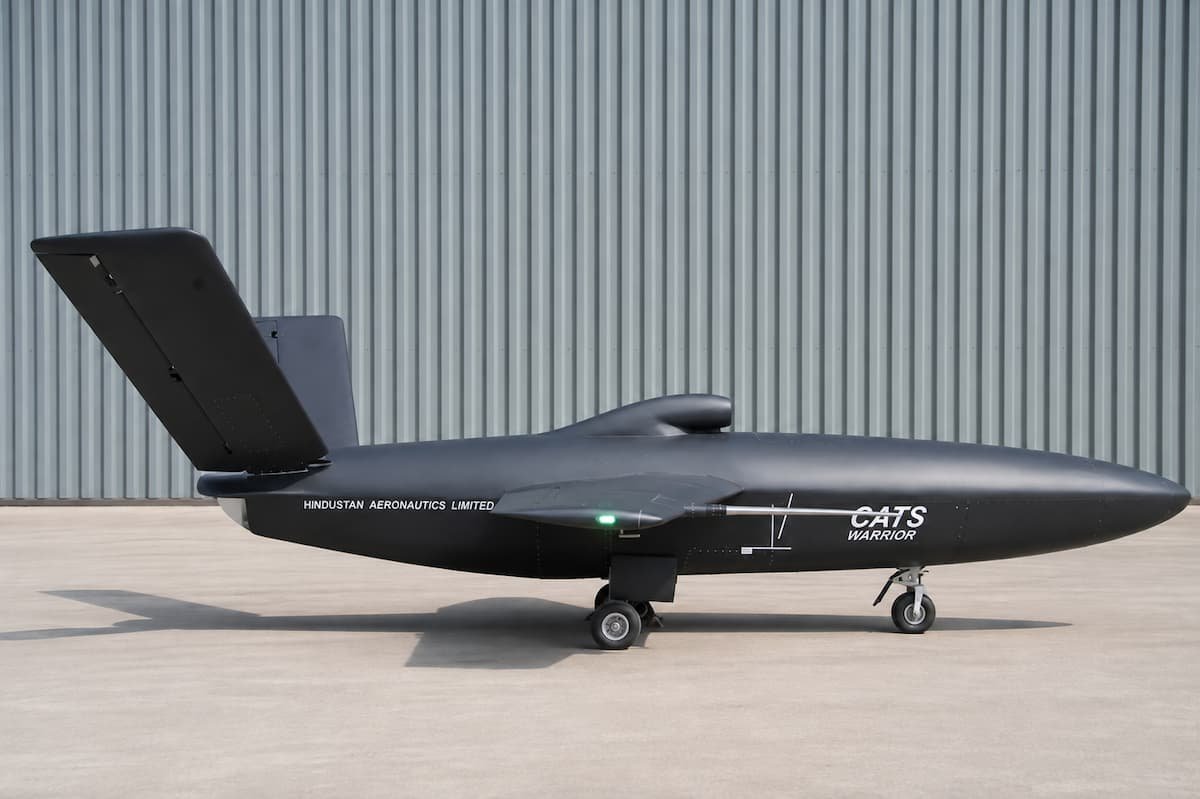
The Drone Question
High-end fighters will remain necessary for air superiority and other missions requiring range, speed, sensors, weapons, and survivability. But some missions may no longer be most efficiently carried out by deploying an expensive crewed aircraft. Surveillance, decoy operations, electronic attack, communications relay, battle-damage assessment and selected strike missions could increasingly involve unmanned or autonomous systems.
The IAF has recognised this emerging requirement. Its technology initiatives have included unmanned systems, swarm technologies, counter-UAS capabilities and manned-unmanned teaming. The Mehar Baba competitions have sought to connect operational requirements with Indian industry and the innovation ecosystem. At the same time, Dronathon-2026 has focused on unmanned and counter-unmanned technologies, autonomous operations, swarms and electronic warfare.
The proliferation of unmanned systems also raises a question considerably larger than how many drones the IAF should acquire. It raises the question of the balance between future exquisite, survivable, and expensive drones and affordable, numerous, and potentially attritable ones.
All-Prevailing Information Superiority
The next major contest will also be over information. The force that can sense first, understand first, decide first and engage first will enjoy a significant operational advantage. This makes sensor fusion central to future air warfare. The IAF already operates a diverse network of airborne and ground-based sensors. The challenge is to fuse information from these systems, and increasingly from unmanned and space-based assets, into a coherent operational picture.
Artificial intelligence could help process the resulting volume of information. But AI should be approached as an enabler rather than a substitute for military judgement. Algorithms can identify patterns, prioritise information and accelerate decision-making, but they remain dependent on data quality, communications, computing infrastructure and the ability to withstand adversarial manipulation. The IAF should therefore pursue AI-assisted command rather than AI-dependent command.
Interconnected Domains
Future conflicts will require simultaneous actions across air, land, maritime, space, cyber and electromagnetic domains. The IAF must therefore be capable of operating both independently as well as an integral part of a broader multi-domain warfighting system.
The IAF’s future will also be inseparable from developments in space and cyberspace. Modern air operations already depend on space-based communications, navigation, surveillance and meteorological information. The degradation of these capabilities could significantly affect combat effectiveness. Air operations need to be integrated with the cyber and space domains. The transition from air power to multi-domain aerospace power is therefore not merely semantic.
Indigenous Capability for Strategic Agility
Indigenisation is another area where the objective needs broadening. The strategic value of self-reliance is not simply that India can manufacture a greater proportion of an aircraft or missile domestically. Its real value lies in freedom of action during a prolonged conflict. Strategic autonomy will be measured by the following abilities: –
- Repair a system when external supply chains are disrupted.
- Modify software rapidly.
- Integrate a new weapon.
- Scale production quickly.
- Identify and replace a vulnerable component.
This requires a deeper defence-industrial ecosystem involving the IAF, DRDO, public-sector enterprises, private industry, start-ups, universities and specialised technology companies.
Tuning the Acquisition Process
Technology-driven capability enhancement and the acquisition process are limited by technological cycles. An aerial platform may justify a long acquisition cycle; however, software capabilities, autonomous systems, or electronic-warfare applications do not. In a rapidly changing scenario, being late can be more dangerous than being imperfect.
A more useful model would combine long-term capability programmes with rapid technology insertion and experimentation. This could include limited initial procurement, operational trials, iterative upgrades and modular architectures.
Personnel and Doctrine are Decisive
New technology alone cannot transform the IAF. The most sophisticated system is useless till the personnel are trained to employ it, operators understand its limitations, and doctrine provides an appropriate framework for its use.
Future airmen will need greater familiarity with data, AI, autonomy, electronic warfare and cyber operations. Pilots will increasingly interact with autonomous systems. Ground personnel will manage increasingly software-intensive platforms. Commanders will have to make decisions based on information generated by multiple machines and humans.
Training consequently needs to evolve. Synthetic environments and advanced simulation should become integral to preparing crews for complex, contested scenarios. Exercises should increasingly test degraded communications, electronic attack, cyber disruption, loss of satellites and attacks on air bases.
Most importantly, doctrine should be developed through experimentation. The IAF cannot afford to wait for a future conflict to reveal whether a new concept works. It needs a permanent institutional mechanism for operational experimentation to test emerging technologies, challenge existing assumptions and translate lessons into doctrine. The organisation that learns faster will possess an advantage over the organisation that merely buys faster.
Transformation not Modernisation
IAF of the future should have the attributes required to prevail in a contested war. It should be:
- Networked, with sensors, shooters and command nodes operating as an integrated system.
- Distributed, capable of generating combat power from multiple locations.
- Resilient, able to sustain operations despite attacks on bases, communications and logistics.
- Autonomous, employing unmanned systems to generate mass, persistence and risk tolerance.
- Technology-absorptive, with institutions capable of rapidly identifying, testing and integrating emerging technologies.
- Indigenous in critical capabilities, providing strategic freedom of action during crisis and war.
- Adaptive, faster than the changes in the character of warfare.
The decisive advantage may ultimately belong not to the air force with the largest inventory or even the most advanced individual platform, but to the one that can sense faster, decide faster, adapt faster and regenerate combat power faster.


