
When the weak rewrite the rules of war, the strong ignore them at their peril
The simplistic explanation of the age-old David and Goliath story is that it was about the improbable triumph of the underdog. But at its core, it is a story about a giant who never understood the contest he had walked into. Goliath came dressed as per his strengths, but David had planned an entirely different fight. Goliath’s mistake was not that he was overconfident. It was that he was conceptually blind.
That blindness has not gone out of fashion. Consider what has unfolded in the last three years alone. In Europe, a country of forty-four million people, with a GDP roughly the size of Portugal’s, has ground down the conventional military ambitions of the world’s second-largest nuclear power. Ukraine has destroyed over three thousand Russian tanks using a combination of NATO-supplied anti-tank missiles, commercial FPV drones that cost less than a mid-range smartphone, and the oldest weapon of all: the refusal to quit.
Elsewhere, Houthi militants from one of the poorest countries on earth have, with missiles and rudimentary drones, disrupted over a trillion dollars in annual Red Sea shipping traffic and forced global supply chains to reroute around the Cape of Good Hope.
None of this is novel. What is new is the scale, the speed, and the technological scaffolding that now makes it possible for the weak to impose costs that were, until recently, the exclusive preserve of the strong.
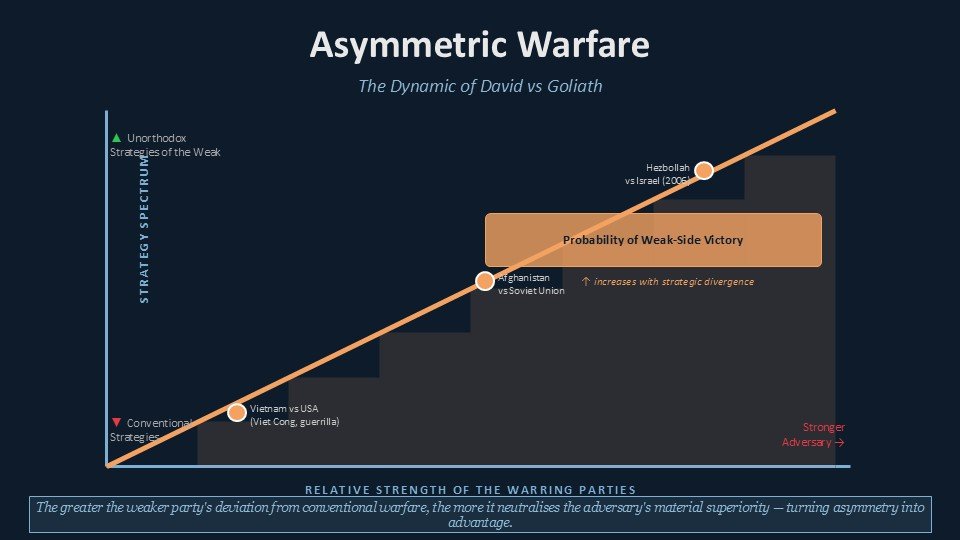
The philosophy of the unequal fight
Asymmetric warfare is a conflict in which the opposing parties differ so substantially in military power that the weaker side would be wise to abandon purely direct confrontation and instead target the gaps – in doctrine, in geography, in time and increasingly, in technology. It is the art of changing the game when you cannot win the game by the stronger player’s rules.
The philosophical lineage of this thought-process is ancient. Sun Tzu counselled ‘be where your enemy is not.’ Mao built an entire doctrine of a protracted war on the premise that time is the weapon of the weak. Lawrence of Arabia, who understood guerrilla war with the intimacy of a practitioner described counterinsurgency as ‘eating soup with a fork.’ The militant, as I have observed elsewhere from my own experience in counter-insurgency operations, is almost invisible: he wears no uniform, carries no distinctive insignia, lives among civilians and is accountable to no law that constrains the use of force. He is not bound by the rules. That is not a disadvantage. It is his entire strategy.
At the heart of every asymmetric contest lies a fundamental asymmetry, not of weapons but of will. The stronger party enters the fight with superior means. The weaker party enters it with superior patience. And history, from Vietnam to Northern Ireland to Afghanistan, has shown with some consistency which of the two lasts longer.
Technology: the great equaliser
What has changed in the contemporary era is that technology has collapsed the barrier to gaining meaningful military lethality. Three shifts, in particular, have turbocharged the asymmetric playbook.
The drone revolution has been the most visible. An FPV drone assembled from off-the-shelf commercial components can now carry a shaped charge capable of defeating battle tanks worth millions of dollars. Ukraine has fielded these in the tens of thousands. Hamas used commercial quadcopters to find the gaps in Israel’s fence for the October 7 attack. The Houthis, backed by Iranian technical support, have held global shipping industry to ransom. The kill-chain — the sequence of steps from identifying a target to destroying it — has been compressed to minutes.
The second shift is in information warfare. The battlefield now extends to the smartphone screen. Zelensky’s decision to remain in Kyiv in the early hours of the Russian invasion — broadcast instantly and globally — was as strategically decisive as any armoured manoeuvre. The weaker party, historically outgunned on the ground, can now own the narrative. Perception, as any serious strategist knows, is not separate from reality.
The third shift is in the proliferation of precision munitions. Anti-tank guided missiles, man-portable air-defence systems, GPS-guided rockets — technologies that once resided exclusively in the arsenals of major powers — are now available at a rate that no arms control framework has kept pace with. The result is a world in which asymmetric capability is no longer a function of state wealth but of ingenuity, access, and will.
The strategic error of the powerful
If there is a single lesson that the United States — the finest conventional military machine in history — has failed to absorb across three decades of asymmetric engagement, it is this: your opponent is not obliged to fight the war by your template.
The Iran case is instructive and should induce genuine intellectual discomfort among Western strategists. The United States spent over two trillion dollars in Iraq and Afghanistan in direct military expenditure. Iran, in the same period, spent a fraction of that sum — arming, training, financing, and directing a ring of proxy militias from Lebanon to Yemen — and emerged from the era of the Global War on Terror more regionally influential than it entered it. The US was expensively optimising for the wrong problem. It built carrier strike groups and stealth aircraft calibrated for peer competition. Iran’s investment in patience and plausible deniability returned higher strategic dividends.
In the recent conflict, Iran did not confront the US and Israel missile for missile – it could not have. Instead, it adopted strategies that its opponents had either not considered or discarded – the blocking of the Strait of Hormuz, the bombing of other countries in the Middle East, and a sophisticated meme war aimed at a domestic US audience.
The Russia-Ukraine war offers the mirror image of the same lesson. Russia expected a 72-hour decapitation strike and swift capitulation. Ukraine, tutored by NATO advisers and armed with asymmetric tools ranging from Javelins to Starlink terminals, converted what was designed as a blitzkrieg into a two-year war of attrition that has bled Russian conventional military capacity to a degree that no Western defence analyst had publicly predicted. Ukraine chose, as its most potent weapon, the strategic relationship with the West to sustain asymmetric resistance long past anyone’s expectations.
The axiom that emerges from both cases is blunt: if you do not understand what game your opponent is playing, you will optimise magnificently for the wrong outcome.
The flashpoints ahead
The world’s next major conflicts are already taking shape in the grey zone of cyber operations, proxy warfare, economic coercion, and narrative manipulation that precedes, and often substitutes for, direct military confrontation.
Taiwan is perhaps the most consequential case. China holds overwhelming conventional superiority. Taiwan’s response has been to build a porcupine — mobile coastal missile batteries, armed drone swarms, hardened civilian infrastructure, and a society being prepared for protracted resistance. The lesson from Ukraine is instructive: if Taiwan can survive the first 72 hours of any assault and impose sufficient costs, the strategic mathematics change entirely. Beijing understands this, which is precisely why its most sustained investments in recent years have not been in amphibious landing craft alone but in information warfare, undersea cable disruption capability.
The India question
India faces its own asymmetric reckoning, and it is not a distant one. Pakistan has, for four decades, run the most successful asymmetric campaign in the subcontinent — bleeding India through proxy militancy at a cost, to Pakistan, that is a fraction of what it has imposed. China, in the grey zone, is advancing across domains — cyber intrusion, infrastructure investment as strategic leverage, salami-slicing along the LAC — that India’s conventional military architecture is not structured to contest.
Three changes are needed, and they are needed within this decade.
The structural imperative is the creation of a dedicated asymmetric warfare command — tri-service, integrated across cyber, drone operations, special forces, and information warfare — that is not an afterthought to conventional planning but a primary instrument of national strategy. Both Pakistan and China have already made this institutional investment.
The strategic imperative is the operationalisation of the grey zone as a deliberate doctrine. India must develop a credible offensive cyber capability, the ability to sustain and influence non-state actors where national interest demands it, and an information warfare infrastructure that does not depend on government press releases for its credibility. Strategic ambiguity must become a policy, not an accident.
But the hardest change and in my experience, always the hardest is the mindset shift in the officer corps. The Indian Army’s magnificent culture, built on orderliness, process, hierarchy, and institutional discipline, is precisely what makes it formidable in conventional war. Those same virtues can become liabilities when the adversary has no interest in conventional war. Asymmetric conflict rewards audacity, improvisation, and a comfort with ambiguity that no drill manual fully teaches. We need officers who can think like insurgents even while commanding battalions.
The final reckoning
In the end, we again return to Goliath. He was not defeated by a sling. He was defeated by a strategic imagination he could not conceive of, wielded by an opponent who had long ago accepted that the only way to win was to refuse to play the game on Goliath’s terms.
The armies, alliances, and nations that will shape the decades ahead are not necessarily those with the largest defence budgets or the most sophisticated platforms. They are those with the greatest strategic imagination and the institutional courage to act on it before the crisis, not during it.
The question for India is not whether asymmetric warfare is coming. It is already here, on both our flanks, advancing daily in domains we have not yet fully learned to contest. The question is whether we are ready to fight it on our terms or whether we will be found, like so many powerful entities before us, still preparing, with great precision and considerable expense, for the last war.
(Maj Gen Neeraj Bali, SM (Retd) is the Director of Chakra Strategic Forum, a think-tank focused on geopolitics and security. The views are his own.)


