
India launched Operation Sindoor the night/ early morning hrs of May 06/07, 2025, targeting nine terrorist camps/ terrorist infrastructure of groups like Lashkar-e-Taiba and Jaish-e-Muhammad in Pakistan and PoK in retaliation to the April 22 Pahalgam terror attack that killed 26 civilians. In multi-domain integrated attacks by the Army, Air Force, and Navy, the operation used precision stand-off weapons, cruise missiles, loitering munitions neutralising terror infrastructure without initially targeting the military targets in Pakistan. This is a rather simplistic description of a military engagement between two nuclear neighbours. This military reprisal by India was described as ‘reckless’ by the western media. The western media woven narrative conveniently did not highlight the undermentioned aspects.
To start with, India redefined limited war victory, something west cannot fathom as an achievement. Arzan Tarapore, in War on the Rocks highlights that Operation Sindoor as orchestrated by India was measured and restrained. This is absolutely against the basic grain of western war fighting, which is characterized by everything big and brutal. From Uri to Balakot to Sindoor, India in a calibrated manner raised the boundaries of what it could do without triggering a war. The western war mandarins just cannot grant this to India. Aniket Udayrao Bhavthankar, very correctly says that India’s strategic restraint in targeting only terror infrastructure in Pakistan in the initial stages of the operation is not evidence of its weakness, but rather a civilizational choice. India by not targeting civilians, unlike the Pakistanis has laid undeniable claim to a reputation as a responsible member of the global community. India’s Chief of Defense Staff General Anil Chauhan said ‘Precision strikes create very little collateral damage’.
Secondly, in employing Air power as the principal responder, which in war planning and executing circles is considered escalatory, India showed the western military planners that Air Power should not be considered ‘escalatory in nature’. It showed that paired with long range precision weapons, air power if used intelligently presents compelling options to expand the threshold even under the nuclear overhang.
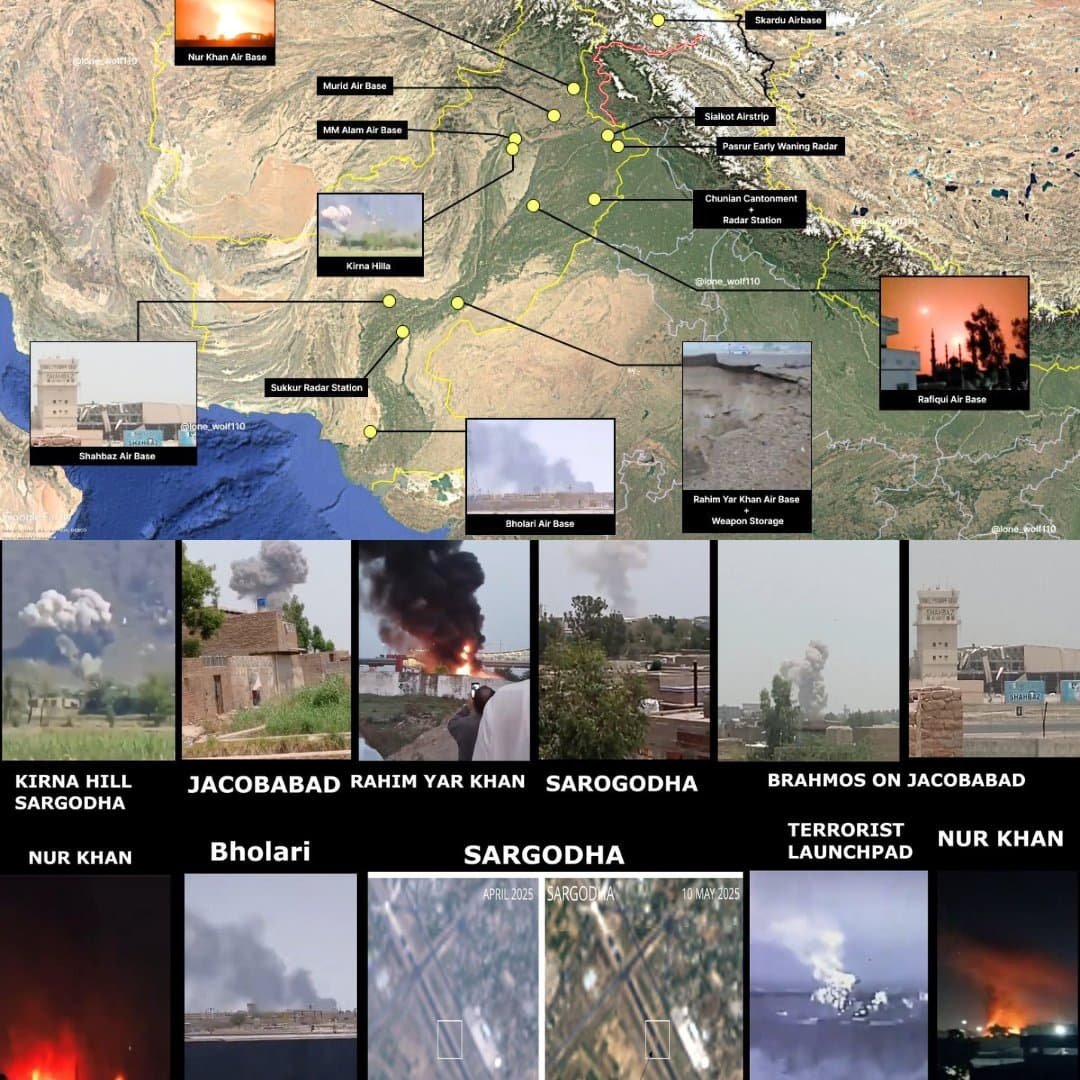
Western outlets focused on unverified Indian jet losses, Pakistani claims of Pakistani civilian casualties, and escalation fears rather than the Indian destruction of Pakistani terror infrastructure, as confirmed by satellite imagery. Thirdly, this selective reporting also downplayed India’s indigenous tech like Akash Air defence missiles, drones and key capabilities like the supersonic cruise missile BrahMos and its integration with Su-30 fighter jets that stood out during the conflict. This is something the western military industrial complex just could not grasp (or was not willing to acknowledge). The icing on the cake was legacy air defence guns and their integration within the overall air defence umbrella. This emerged as a gainful solution to counter small drones. This low-cost intelligent achievement has eluded the said complex in the Russo-Ukraine war.
Fourthly, another aspect that did not get due acknowledgement were the non-western weapons used by India, namely the Air Defence missile system S-400 and supersonic cruise missile Brahmos (one pure Russian & one developed in collaboration with Russia). In their employment during Op Sindoor, both weapons destroyed their allotted targets in the air and on ground. S-400 and Bramhos (along with other non-US weapons) were the conflict winners. S-400 shot down a western AEW&C aircraft and Chinese fighters with impunity. Brahmos on the other hand breached Western and Chinese AD systems and other military targets on ground. Brahmos was literally ‘unstoppable’.
Targets in Pakistan that were engaged (as per the Satellite Imagery) were mostly western and the implications are therefore monetary also. Fifthly, this conflict showed primacy of wisely used Russian and home-grown Indian weapon systems. This success is unacceptable for the businesses of the western military hardware providers. The all-powerful western military industrial complex, which is in direct competition with Russia and in places China, like any manufacturer survives on sale quantities. It cannot allow the showcasing of the successes of Russian / Russian collaborated equipments / weapons getting the better of their western counterparts. This is so with the Russia-Ukraine conflict still raging after almost four years. Against this backdrop, the western (media) narrative vis-à-vis India in Op Sindoor was controlled by powers that be in the initial stages and hence emerged as biased.
Sixthly, the focus of the Western Narrative vis-à-vis Op Sindoor was to shortchange India. Unable to uptake the Indian Tactics & Strategy, it was easy for the western media to do what they do best – paint India as the aggressor. The western media’s reluctance to clearly report India’s superior performance during Operation Sindoor showcases a broader tendency in its journalism to avoid acknowledging India’s increasing military sophistication and capabilities. Major media outlets consistently reported the conflict as a mutual exchange of hostilities and not admitting the wide difference in military effectiveness of India and Pakistan. UK based The Morung Express brings out that despite satellite evidence showcasing India’s operational successes, the Western media reporting was showing false equivalency.
Lastly, Western support for Pakistan, post Op Sindoor was majorly due to the Indian Victory and also because Operation Sindoor was an effective and efficient demonstration (for all to see) of calibrated use of force. It signaled resolve and demonstrated competence – without crossing the proverbial line into broader war. As brought out by Air Chief Marshal AP Singh, the CAS, Op Sindoor highlighted that India as a victor knew when to stop the conflict. Militarily speaking, the operation was not representational but rather an example of how to apply decisive power (air Power in this case) unambiguously and effectually at all levels. John Spencer, a prominent U.S. military veteran and head of the Urban Warfare Studies at the Modern War Institute in New York, noted that Operation Sindoor met and exceeded its strategic objectives of dismantling the terrorist infrastructure in Pakistan, demonstrating Indian military superiority, restoring deterrence, and unveiling of a new robust national security doctrine.
An important aspect that needs highlighting is the quality of the Indian media’s coverage of Operation Sindoor, which was largely amplifying hyper-nationalistic narratives. It however fell short on verification and balance. This is what the Western media highlighted. A more responsible approach should have prioritized factual accuracy and strategic narrative-building to bolster India’s global position. Media’s focus should not have been driven by the ‘fastest finger first to breaking news approach’ but an intellectual portrayal of India’s demonstrated escalation dominance and a new deterrence doctrine. Highlighting international praise for restraint e.g., Washington Post’s “measured show of force” would have only added to the psychological edge India had gained in making Pakistan’s nuclear threats hollow. India’s restraint was not weakness, it was maturity. It imposed costs and redefined thresholds. This should have been emphasized by the Indian media. This does not need issuance of a government dictat on the subject.
Modern warfare which is multi-domain in nature — land, sea, air, space and cyber—now has weaponized narrative as the sixth domain of warfare. The narrative therefore must be ever-evolving crisis-responsive, mission-ready, rehearsed and resourced. This is typical of Western approach to narrative – it is ever ready.
India’s adversaries—both state and non- state—operate 24/7 in the Information domain. Control over the story shapes control over outcomes, perceptions and hence partnerships. As India emerges as a regional and global power, it must not just win battles; it must also win belief. The western media has its own interests and it will take time before western media becomes user friendly for India. The Indian narrative has to therefore cogently point out the predispositions in the western media. Indian media should speak in unison, smartly, matter-of-factly and intelligently to shape perception(s) more effectively, because in this new age of war, the last bullet no longer ends the conflict. The last word does. Indian media therefore has to back each other to – HIGHLIGHT, WHAT THE WESTERN NARRATIVE DOESN’T.
References:
- John Spencer made this statement in a detailed analysis shared on X (formerly Twitter). Also quoted in Operation Sindoor Strategic Success, Decisive Indian Victory, Says Modern War Institute’s John Spencer
- Curated By: News Desk News18.com May 17, 2025, and ‘Operation Sindoor a decisive victory in modern warfare’: Chair of urban warfare studies John Spencer ; OpIndia 14 May 2025.
- The phrase “measured show of force” in relation to Operation Sindoor was attributed by India Today to The Washington Post in their headline coverage titled ‘Calculated, measured show of force: How foreign media reported Operation Sindoor’ by Nakul Ahuja on May 7, 2025 09:54 IST
- Western media reluctant to acknowledge India’s military sophistication during Op Sindoor: Report, The Morung Express, 13th August 2025
- Western media reluctant to acknowledge India’s military sophistication during Op Sindoor: Report, The Morung Express, 13th August 2025
- The comments by ACM AP Singh, the CAS came during his address on September 19, 2025, where the CAS highlighted India’s disciplined restraint.
- Operation Sindoor and the Evolution of India’s Military Strategy Against Pakistan, Arzan Tarapore, War on the Rocks,19 May 25
- Operation Sindoor, Strategic Restraint, and the Teachings of The Mahabharata, Aniket Udayrao Bhavthankar, October 13, 2025
- Comment by India’s Chief of Defense Staff General Anil Chauhan, while speaking about the evolving nature of warfare. on August 26, 2025. The quote appears in a Carnegie Endowment for International Peace article titled “Military Lessons from Operation Sindoor,” by Dinakar Peri published October 6, 2025.
- Carnegie Endowment for International Peace article titled “Military Lessons from Operation Sindoor,” by Dinakar Peri published October 6, 2025


