
A Strategic Analysis of the Hormuz Crisis, Its Inevitable Resolution, and Why India Will Be the Largest Beneficiary
Wars end. All of them. The question that serious analysts must ask is not whether this one will end, but why it will end, when it will end, and what the world looks like on the other side. The current conflict around the Strait of Hormuz — the Iranian nuclear standoff, the US naval blockade, the shutdown of the world’s most important oil chokepoint — is no exception. The pressure on every party involved is already overwhelming. The diplomatic architecture for a settlement is already being assembled. And the signs, for those willing to read them carefully, point unmistakably toward resolution.
This article makes the case — systematically, evidence by evidence — for why this war will end. It examines the economic forces that make a prolonged conflict impossible for the combatants, the diplomatic signals that are already pointing toward a deal, the military realities that neither side can wish away, and the geopolitical re-alignments that are quietly pushing all parties toward the table. Only once that case is made in full does it turn to the question of who benefits — and why India, perhaps counterintuitively, is positioned to emerge as the largest strategic winner of the entire episode.
1. The Economic Case — No One Can Afford to Continue
The most powerful argument for why this war will end is the simplest: it is destroying the economies of those waging it, and doing so at a speed that makes prolonged conflict financially suicidal. Wars sustained by ideology and pride eventually encounter the hard wall of arithmetic. That wall has already been reached.
Begin with Iran. The Strait of Hormuz blockade has cost Iran approximately $400 million per day, or $13 billion every month. Those numbers come not from hostile Western sources but from the country’s own Central Bank and from financial analysts tracking real ship movements and oil flows. Daily crossings through the Strait, which averaged over 15,000 at their peak, fell to near zero within the first days of the blockade. The grey network of shadow tankers, ship-to-ship transfers, flag-of-convenience vessels, and UN-based payment workarounds that Iran had painstakingly assembled over years of sanctions experience — a network many analysts believed was untouchable — has been effectively dismantled.
Iran’s Central Bank has issued an extraordinary public warning: unless current conditions change, domestic inflation will exceed 180%. That is not normal inflation; it is hyperinflation — the kind that destroys the savings of ordinary citizens overnight, wipes out the middle class, and generates civil unrest that no government, however authoritarian, can indefinitely contain. The Bank Governor has gone further, directly advising the government to reach an agreement with the United States and to lift internet restrictions — a public acknowledgement, from inside the system, that the war is not winnable on current terms. The Bank’s own assessment is that the economic damage will take twelve years to repair. Two million people face unemployment. A food crisis, reported by Iran watchers on the ground, is already beginning to take hold.
“Iran’s Central Bank has warned that unless current conditions change, inflation will hit 180%, two million will lose their jobs, and economic damage will take twelve years to repair. The Bank Governor has publicly advised the government to reach a deal with the United States.”
It is worth dwelling on what these numbers mean in human terms. 180% inflation means that a family’s monthly grocery bill, which might have been 10,000 rials in January, exceeds 28,000 rials by December — while salaries remain frozen or fall in real terms. It means families choosing between food and medicine. It means the social contract between the government and its citizens — which in Iran, as everywhere, ultimately rests on the state’s ability to deliver a manageable standard of living — begins to crack. Iran’s government is not indifferent to this. It cannot be. The Green Movement of 2009, the 2019 fuel protests, the 2022 protests over Mahsa Amini’s death — each was triggered by an accumulation of economic grievances. The Central Bank’s warning is, in effect, a warning that the conditions for another and potentially larger wave of civil unrest are being actively created.
The pressure from China compounds the pressure on Iran. China was Iran’s largest customer, absorbing Iranian crude through an elaborate system of workarounds that kept Tehran financially afloat through the harshest periods of Western sanctions. That system no longer works. One Chinese vessel has already been detained. The prospect of further detentions — humiliating for a country projecting great power status — hangs over every shipment. China’s own media, including the South China Morning Post, has openly asked whether the blockade threatens the upcoming Trump-Xi summit in Beijing. The answer, which Beijing will not say publicly, is yes. China needs that summit. It needs the trade relationship with the United States. It cannot and will not sacrifice both for Tehran. When China eventually — quietly, through intermediaries — tells Iran that continued resistance is not in their mutual interest, that signal will be decisive.
The economic pressure is not only on Iran. China faces a compounding energy crisis of its own. Approximately 42% of China’s crude oil originates from Gulf nations. An additional 10 to 12% is Iranian crude. Combined, over 54% of China’s crude imports are either blocked or severely disrupted by the current crisis. A third of China’s LNG supply comes from the Middle East, with Qatar supplying 28% of Chinese LNG imports alone. China’s teapot refineries — smaller, independent operations that were heavily dependent on cheap Iranian crude — are operating at 30 to 40% below normal throughput. These are not manageable inconveniences; they are structural shocks to an economy already facing a property sector crisis, youth unemployment at historic highs, and slowing export growth.
The combined economic pressure on both Iran and China — one through direct financial destruction, the other through collateral energy disruption — creates an overwhelming incentive for both to seek resolution. This is not a situation either can simply wait out.
2. The Military Reality — What Force Cannot Achieve
A second reason this war will end is that neither side has a military path to the outcome it actually wants. Wars fought without a clear military path to political objectives inevitably drift toward negotiation. This one is drifting there faster than most.
Iran’s strategic doctrine in the region — using proxy forces, controlling access to the Strait, maintaining an enrichment programme as a deterrent — has suffered serious damage. Hezbollah, one of Iran’s most powerful instruments of regional influence, is being squeezed simultaneously.
Lebanese public opinion has shifted dramatically; the sentiment heard on Lebanese television — that Hezbollah and its weapons, its rockets, its supreme leader allegiance should leave — would have been unthinkable five years ago. Israel’s sustained military campaign has degraded Hezbollah’s capabilities and altered the political environment in which it operates.
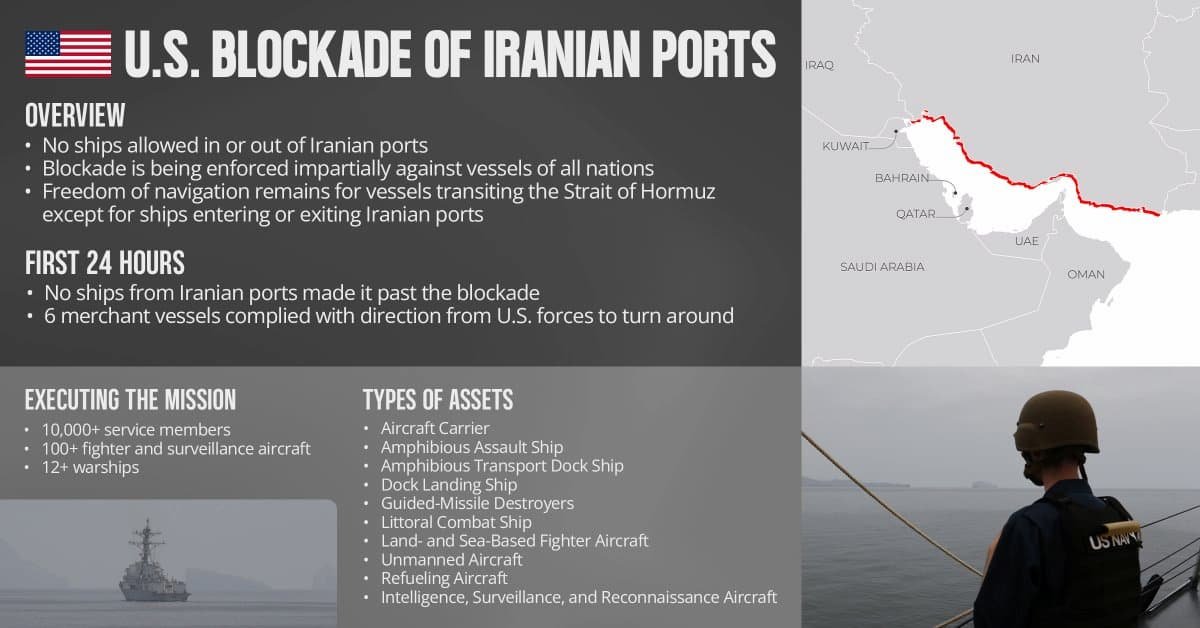
Meanwhile, the US Navy is not merely blockading Iranian ports in the abstract. Three major Iranian ports — Bandar Abbas, Bushehr, and Chabahar — are under active patrol. Any vessel attempting to enter or leave these ports is being intercepted. The US has been explicit about which vessels and which routes are affected, and which are protected — a precision that signals this is a controlled, calibrated operation, not a declaration of unlimited war. The message is deliberate: Iran’s economic lifeline can be turned off or on. That gives the United States enormous leverage at the negotiating table.
Iran’s military response options are limited by this reality. A direct strike on US naval assets would trigger a military escalation that Iran, in its current economic condition, is in no position to sustain. Closing the Strait entirely — a threat Iran has made repeatedly over the years — is only powerful as a threat. The moment it is executed, as it effectively has been, the economic consequences fall on Iran as much as on anyone else. Iran cannot sell the oil it cannot ship. The weapon of chokepoint control becomes a weapon pointed at its own economy the moment it is actually used.
There is also the matter of Iran’s nuclear programme itself. The US red lines — a twenty-year freeze on enrichment and removal of all enriched material from Iranian territory — are demanding. But they are not existential demands for the Iranian state. They do not require regime change. They do not require Iran to abandon its military or dismantle its government. They require a verifiable pause and a transfer of stockpile to a trusted third party — Russia has already offered to manage this. Iran retains sovereignty, retains its institutions, and retains the capacity to rebuild its programme if circumstances change. The framework for a face-saving agreement exists.
“Iran cannot sell the oil it cannot ship. The weapon of chokepoint control becomes a weapon pointed at its own economy the moment it is actually used.”
3. The Diplomatic Architecture — A Deal Being Built in Plain Sight
The third reason this war will end is the most specific and the most encouraging: the diplomatic architecture for a settlement is already visible. Peace processes rarely announce themselves. They are assembled quietly, through back channels and intermediary shuttles, through the gradual narrowing of stated positions and the accumulation of small agreements that make a larger one possible. All of those processes are currently underway.
The most significant signal came from Iran itself. Tehran has formally proposed a five-year suspension of nuclear enrichment activities. Five years is not twenty — the US position — but it is not zero. It is an opening bid in a serious negotiation. The gap between five and twenty years is a negotiating gap, not a chasm of principle. Both sides are talking about duration, not about whether a pause is possible. That distinction matters enormously.
US envoys have noted publicly that Iranian negotiators were unable to close a deal because they lacked a clear directive from the Supreme Leader — they needed to return to Tehran for authorisation on specific terms. This is routinely misread as obstruction. It is not. It is the normal functioning of a regime that does not delegate final authority on existential questions to its negotiating team. It means the Iranian side is taking the talks seriously enough to require top-level sign-off. Talks that are not serious are abandoned, not referred upward.
Meanwhile, Russia has renewed its formal offer to manage Iran’s enriched uranium stockpile — storing it on Russian territory under international supervision. This is a concrete, verified solution to the US’s core demand that enriched material not remain in Iran. It gives Iran a face-saving alternative to destruction or surrender: the material is not destroyed, it is merely relocated, to a country Iran trusts. The practical obstacle to a deal on the nuclear question has a practical answer.
Iran has simultaneously reopened direct diplomatic outreach to Saudi Arabia for the first time in over four years. This is a seismic shift in regional politics. Saudi Arabia and Iran have been the twin poles of the Sunni-Shia rivalry that has destabilised the region for decades. Saudi Arabia’s quiet re-engagement with Tehran is being driven by a calculation that a prolonged conflict is bad for Gulf stability, bad for oil markets, and bad for Saudi Arabia’s own ambitious modernisation agenda. Reports suggest Riyadh is actively pushing for a diplomatic settlement. The most implacable regional rival is now a mediating force.
North Korea — in a development that would have seemed fantastical six months ago — has publicly offered to assist in mediation. Kim Jong-un’s government, newly on the path of its own rapprochement with South Korea, has framed global peace as a strategic priority and explicitly offered to broker. Whatever one makes of North Korea as a diplomatic actor, the signal is clear: the geopolitical ground is shifting. Countries that were formerly reliable members of the anti-US coalition are repositioning. The coalition of those willing to help Iran hold out is shrinking; the coalition of those quietly pushing Tehran toward the table is growing.
“Iran has proposed a five-year moratorium on enrichment. Russia has offered to manage Iran’s enriched uranium stockpile. Saudi Arabia has reopened direct outreach to Tehran after four years. The architecture of a deal is being assembled in plain sight.”
And crucially: the ceasefire is holding. Iran is not violating it. This matters more than any statement from any official. In conflict, actions define intent more precisely than words. Iran’s restraint under the ceasefire — even as it issues defiant statements for domestic consumption — signals that the government understands the limits of its position. If the ceasefire continues to hold, the demining of Omani and Emirati territorial waters can begin. If demining begins, a phased reopening of the Strait becomes operationally feasible. A phased reopening becomes the foundation for a broader normalisation agreement.
The pathway to peace is not guaranteed, and it is not linear. There will be setbacks, provocations, and moments when the deal looks impossible. But the direction of travel is clear, and the structural forces pushing all parties toward resolution — economic, military, diplomatic — are powerful, convergent, and accelerating.
4. The Geopolitical Re-Alignment — The World Is Moving On Without Iran
The fourth and perhaps most underappreciated reason this war will end is that the world is re-aligning around Iran — not in support of it. The network of relationships and dependencies that gave Iran strategic leverage is being systematically reshaped. Iran is running out of time to negotiate from a position of any strength at all.
China, as argued above, cannot indefinitely sustain its strategic ambiguity. The longer the blockade holds, the harder it becomes for Beijing to maintain the posture of principled neutrality. China’s energy companies are already looking elsewhere — at American LNG, at Australian coal, at accelerated domestic nuclear — to compensate for Middle Eastern supply disruption. Every alternative supply chain China develops is one less piece of leverage Iran holds over Beijing. China’s dependence on Iranian crude is a wasting asset for Tehran; it diminishes with every month of crisis.
Russia has moved explicitly toward a mediating posture. Moscow’s renewed offer to store Iran’s enriched uranium is not merely a practical proposal; it is a diplomatic signal that Russia’s unconditional support for Iran’s strategic position has limits. Russia needs Iran as a partner but needs a functional global energy market even more. Russian diplomatic language toward Tehran — encouraging negotiation, urging restraint — has shifted noticeably. Iran’s most powerful external patron is quietly pushing it toward a deal.
Indonesia has announced a major defence cooperation agreement that reshapes the strategic balance around the Malacca Strait — the other great chokepoint of Asian commerce. This development signals that regional powers are not waiting for the Iran crisis to resolve itself; they are restructuring the regional order around it. Every such restructuring further reduces Iran’s strategic leverage by creating alternative routes and alternative security arrangements.
Lebanon, meanwhile, is undergoing its own reckoning. The sentiment among ordinary Lebanese — that Hezbollah’s weapons, its Iranian patronage, and its capacity to drag Lebanon into conflicts not of Lebanon’s choosing must end — is increasingly audible. Lebanon has been hollowed out by Hezbollah’s dominance; its economy destroyed, its state institutions paralysed, its sovereignty effectively mortgaged to Tehran. The Lebanese public is saying, loudly and without the previous inhibition, that they want their country back. This matters because Hezbollah’s domestic legitimacy — not just its military capability — is the foundation of Iran’s regional influence. If that legitimacy continues to erode, Iran’s regional position erodes with it.
Taken together, these re-alignments constitute a slow but inexorable narrowing of Iran’s options. Every month of conflict costs Iran money it does not have, allies it cannot replace, and leverage it cannot rebuild. The window for a deal that gives Iran anything close to acceptable terms is open now — but it will not remain open indefinitely.
5. The Human Dimension — When Populations Say Enough
Behind every geopolitical calculation is a human one. Governments respond to military pressure and diplomatic incentives, but they also respond to the accumulated weight of popular exhaustion. Iran’s government is not immune to this pressure — and the signals coming from Iranian society suggest that exhaustion is deepening rapidly.
Iran’s population has lived through forty years of sanctions, economic mismanagement, and the accumulated costs of regional adventurism. The revolutionary generation that brought the Islamic Republic to power is aging. The generation that has grown up under it — educated, connected, aware of how their peers in neighbouring countries live — has expressed its frustrations repeatedly and at great personal risk. The 2019 fuel protests, the 2022 Mahsa Amini protests, and the rolling economic demonstrations that have continued in smaller forms since — each reflects a population whose tolerance for sacrifice in the service of ideological goals is not limitless.
The current crisis is adding a new layer of material suffering on top of those existing grievances. Hyperinflation at 180% does not affect Iran’s Revolutionary Guards or its nuclear scientists or its senior clerics; they have access to foreign currency and protected supply chains. It affects the schoolteacher, the factory worker, the small business owner, the university student. It affects precisely the people who have already demonstrated their willingness to take to the streets.
Iran’s government is aware of this. The Central Bank Governor’s public advice to seek a deal is not merely an economic assessment; it is a political warning. The food crisis taking hold in parts of Iran is not merely a logistical inconvenience; it is a recruitment poster for the next wave of protest. The Iranian government has suppressed protests before, at great cost and with diminishing returns to its legitimacy. A government facing simultaneous military pressure, economic collapse, international isolation, and popular unrest is a government that will eventually choose survival over principle.
“The Iranian government knows that 180% inflation does not hurt its generals or its clerics. It hurts the schoolteacher, the small business owner, the university student — the same people who took to the streets in 2019 and 2022. Governments facing this combination of pressures do not fight indefinitely.”
This dimension of the crisis is often missed in purely strategic analyses. But wars end when the human cost becomes intolerable, and the people bearing that cost make clear — through protest, through emigration, through economic non-cooperation — that they will not continue to do so. All the evidence suggests that point is approaching in Iran faster than its government would like to admit.
6. The Timeline — How This Ends
Based on the analysis above, the most likely trajectory is as follows — not a prediction, but a rational reading of where the structural forces are pointing.
In the near term, mediators will continue to shuttle. The gap between Iran’s five-year moratorium offer and America’s twenty-year demand will narrow through intermediary proposals. Russia’s offer to manage Iran’s enriched uranium provides the practical mechanism for a deal on the core nuclear question. Saudi Arabia’s quiet mediation provides the regional legitimacy. The question is not whether these mechanisms exist — they do — but whether Iran’s leadership will authorise its negotiators to use them.
The ceasefire will continue to hold, for the same reasons it has held so far: Iran cannot afford to violate it. As the ceasefire holds, confidence-building measures become possible — perhaps the release of specific prisoners, perhaps the opening of a humanitarian corridor, perhaps a partial easing of restrictions on specific ports. Each small agreement creates the political space for a larger one.
The economic pressure will deepen before it eases. Iran’s financial reserves are not unlimited. As the weeks become months, the Central Bank’s warnings will become more urgent, the food situation more acute, and the social pressure more intense. This does not mean collapse is imminent — Iran has survived remarkable economic adversity before — but it means the cost of holding out increases with every week that passes.
At some point — and the balance of evidence suggests sooner rather than later — the Iranian leadership will make the calculation that a deal on nuclear terms is preferable to a decade of reconstruction from economic ruin. When that calculation is made, the deal will come quickly, because the framework is already in place. Russia stores the enriched uranium. The US agrees to a moratorium longer than five years but shorter than twenty — perhaps ten or twelve, with verification mechanisms. Iran gets sanctions relief and access to the global economy. The Strait reopens. The world exhales.
This is not a happy ending for Iran’s regional ambitions. It is not a victory. But it is survival — and survival, for any government, is ultimately the priority that overrides all others.
7. And Then There Is India — Why the Settlement Makes India a Winner
With the case for the war’s end firmly established, we turn to the secondary — but important — question: who benefits most from both the crisis and its resolution? The answer, across multiple dimensions, is India. This is not accidental. It is the product of strategic preparation, diplomatic skill, and infrastructure investment that has been building for years and is now paying off at precisely the right moment.
Robert Kiyosaki, the author of Rich Dad Poor Dad, captured it memorably – India is playing chess while others are playing checkers. The Iranian ambassador to India has publicly confirmed that India does not pay tolls on Iranian crude. The US tacitly accepts India’s continued energy engagement with Iran. Russia actively prefers India as an energy customer over China. Brazil, Angola, Qatar — every major energy exporter is competing to supply India. The IEA projects India will be the world’s largest source of oil demand growth by 2030. India has made itself indispensable to every side.
India’s structural advantage rests on its refining capacity — the fourth largest in the world at 258.1 million metric tonnes per annum, running at over 103% of capacity, exporting refined products worth USD 45 billion annually to over 50 countries. India imports crude from 40 nations, with 70% of its supply routed through channels independent of the Strait of Hormuz. Whatever crude India gets — at whatever price, from whatever source — it refines it, subsides the domestic consumer, and exports the premium product. It is making money on both ends of the transaction.
In clean energy, India has crossed 150 gigawatts of solar capacity — third globally, having added a record 44.61 GW in fiscal year 2025-26. It achieved 50% non-fossil electricity capacity five years ahead of its Paris Agreement target. It is building toward 500 GW of non-fossil capacity by 2030. Every gigawatt installed is a barrel of crude India does not need to import, a piece of vulnerability to the Hormuz chokepoint eliminated.
And on April 6, 2026, the Prototype Fast Breeder Reactor at Kalpakkam achieved criticality — making India only the second country in the world, after Russia, to operate a commercial fast breeder reactor. This reactor is the bridge to India’s three-stage nuclear programme, which ultimately harnesses India’s own coastal thorium deposits — 25% of the world’s known reserves — to power the country for an estimated 60,000 years on indigenous fuel. When that programme reaches its conclusion, India’s energy independence will be complete.
“India is not merely enduring the Hormuz shock — it is using the shock on others. It is buying cheap crude, running refineries above capacity, and exporting premium refined products. It is making money from a crisis that is destroying everyone else.”
When the deal comes — when the Strait reopens and Iranian oil begins to flow freely again — the first beneficiary will be India. Not because India has been lucky, but because India has spent years making sure it would be. India never abandoned Iran diplomatically. India never sanctioned Tehran. India never humiliated the Iranian government publicly. And so when normalisation comes, the Iranian ambassador’s public statement will be the opening chapter of a new economic relationship, not a diplomatic courtesy.
Three countries stand to gain from the disruption and its resolution: the United States, Russia, and India. Of the three, India is the only one that carries no sanctions risk, no conflict liability, no diplomatic downside. The US gains economically but bears the costs of being the principal belligerent. Russia gains economically but remains under sanctions. India gains economically and diplomatically, from all sides, with no corresponding liability.
That is what it means to play the long game. That is what it means to have a strategy that survives the chaos of events rather than being shaped by them. And that is why, when historians look back at the Hormuz crisis of 2026, they will note that one country saw it coming, prepared for it, navigated it with extraordinary skill — and came out the other side stronger than it went in.
Summary – Why This War Will End — The Five Converging Forces
Economic collapse – Iran loses $400 million per day; 180% inflation projected; food crisis emerging; Central Bank publicly calls for a deal
Military stalemate– Iran has no viable path to its objectives; US controls the chokepoint precisely; the nuclear weapon of threat is spent the moment it is used
Diplomatic architecture -five-year moratorium proposed by Iran; Russia offers to store enriched uranium; Saudi Arabia mediating; ceasefire holding
Geopolitical re-alignment – China, Russia, and regional powers all quietly pushing Iran toward the table; Iran’s coalition is shrinking
Human exhaustion -Iranian society has borne forty years of sanctions and sacrifice; hyperinflation is the last straw; governments facing this combination do not fight indefinitely
Sources
Iran Central Bank statements (April 2026); US Special Envoy briefings; Al Jazeera English (Hormuz blockade and Lebanon coverage); South China Morning Post (China-Hormuz analysis); New York Times (Iran nuclear negotiations); Axios (Iran mediator reporting); Department of Atomic Energy, Government of India (PFBR criticality, April 6, 2026); Ministry of New and Renewable Energy — MNRE Physical Progress Report (March 2026); Ministry of Petroleum & Natural Gas, PIB releases (2024–26); US Energy Information Administration — EIA India Country Analysis (2025); S&P Global Energy (India Refining Capacity Outlook, January 2025); International Energy Agency (February 2024 projection); International Renewable Energy Agency — IRENA Statistics (December 2025); World Nuclear News (PFBR criticality report, April 2026); Nikkei Asia (India-Russia energy cooperation); IBEF India Oil & Gas Sector Report (2025–26); PV Magazine (India 150 GW solar, April 2026).


