
The Indian Navy commemorated a landmark achievement in its aviation history with the successful graduation of the Second Basic Hawk Conversion Course held at INS Dega, Visakhapatnam. In a dignified and solemn ceremony, Lieutenant Atul Kumar Dhull and Sub Lieutenant Aastha Poonia were awarded the prestigious ‘Wings of Gold’ by Rear Admiral Janak Bevli, Assistant Chief of Naval Staff (Air). This milestone not only marks the professional excellence of these officers but also signifies a progressive shift in the Indian Navy’s commitment to inclusivity and operational excellence in naval aviation.
Second Basic Hawk Conversion Course: First Female Officer In Naval Aviation
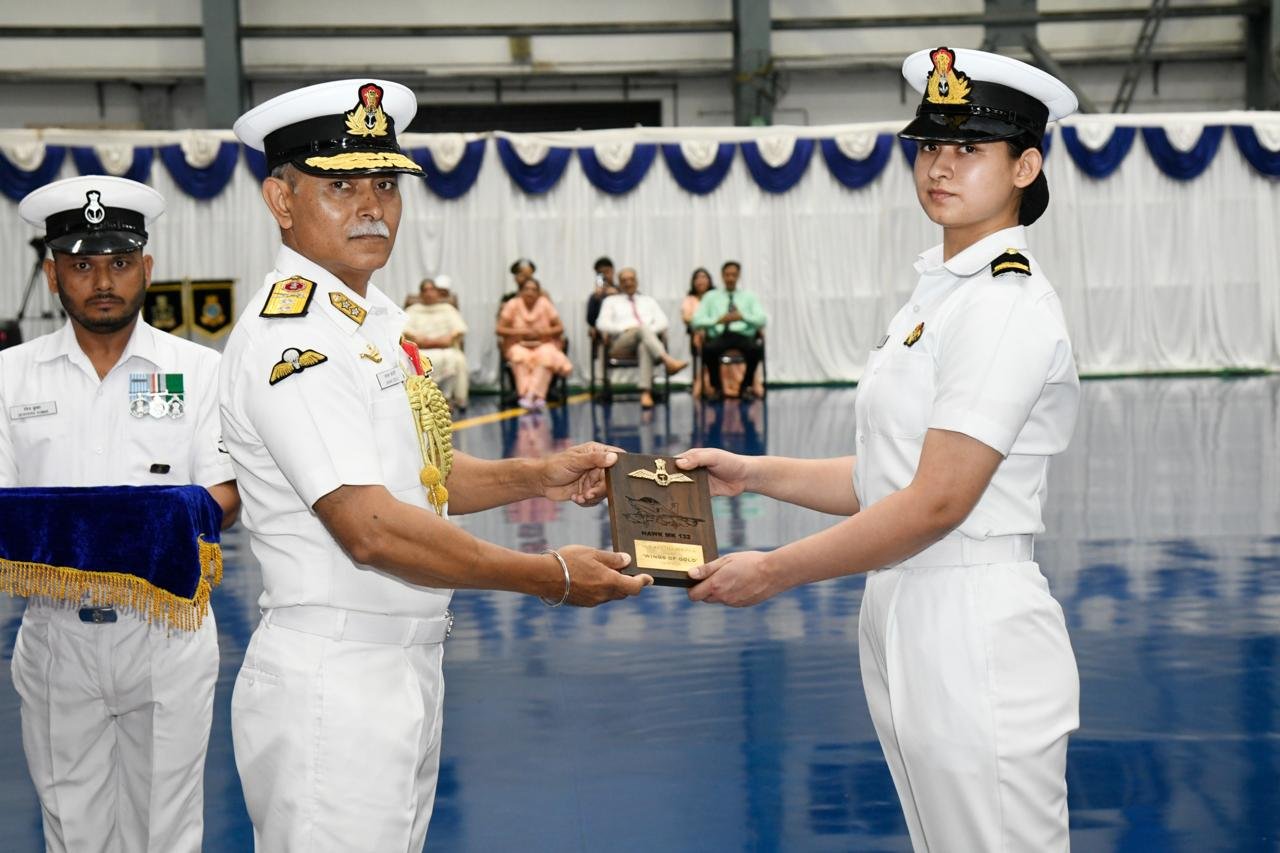
The highlight of the event was the historic achievement of Sub Lieutenant Aastha Poonia, who became the first female officer to be streamed into the Fighter stream of Naval Aviation. This unprecedented accomplishment firmly establishes her as a trailblazer, breaking long-standing gender barriers within the armed forces and heralding a transformative chapter in the Indian Navy’s evolving aviation capabilities.
Nari Shakti in Naval Aviation: Breaking New Ground
With the induction of Sub Lt. Aastha Poonia into the Fighter stream, the Indian Navy takes a significant leap in its pursuit of gender integration in combat roles. While women officers have been previously inducted as Maritime Reconnaissance (MR) Pilots and Naval Air Operations Officers, this marks the first instance of a woman being streamed into a combat fighter trajectory within Naval Aviation.
This move aligns with the broader vision of the Government of India and the Ministry of Defence to bolster Nari Shakti (Women Power) within the Armed Forces. It reflects policy shifts geared towards fostering equal opportunities, removing structural barriers, and empowering women officers to contribute to national defense in the most operationally demanding roles.
Advancing Naval Aviation: Training and Transformation
The Basic Hawk Conversion Course, an essential part of the Naval Jet Training Curriculum, is designed to provide naval aviators with advanced jet flying skills, operational knowledge, and mission readiness. Conducted at INS Dega, a premier naval air station on India’s eastern seaboard, the course leverages the BAE Systems Hawk Advanced Jet Trainer—a state-of-the-art platform known for its agility and mission versatility.
The completion of this rigorous training cycle underscores the Indian Navy’s steadfast commitment to building a technologically superior and combat-ready aviation arm, aligned with the strategic imperatives of maritime security. The Hawk AJT (Advanced Jet Trainer) serves as a critical bridge between basic flying training and front-line fighter operations, preparing naval aviators for eventual deployment on carrier-based platforms such as the MiG-29K and future aircraft under Project TEDBF (Twin Engine Deck-Based Fighter).
Strategic Significance and Future Trajectory
Rear Admiral Janak Bevli, ACNS (Air), in his keynote address, emphasized the Navy’s strategic focus on capability enhancement through talent diversification. He lauded the grit, professionalism, and determination demonstrated by both graduates, highlighting their role in strengthening the Indian Navy’s Combat Air Arm.
The Indian Navy’s aviation roadmap includes the induction of indigenous platforms such as the Naval LCA (Light Combat Aircraft) and the future TEDBF, both developed by the Aeronautical Development Agency (ADA) and Hindustan Aeronautics Limited (HAL). The successful streaming of female officers into these platforms is a strong signal of the Navy’s future-readiness and commitment to a balanced and combat-capable force structure.
Second Basic Hawk Conversion Course: A Defining Moment for the Fleet Air Arm
The graduation ceremony of the Second Basic Hawk Conversion Course represents more than a personal milestone for Lt. Dhull and SLt. Poonia. It symbolizes the Indian Navy’s progressive approach toward modernizing its Fleet Air Arm, reinforcing operational excellence, and championing gender equality in uniformed service.
As Sub Lieutenant Aastha Poonia takes her place in the fighter cockpit, she not only soars as a pilot but also as a symbol of the Navy’s inclusive future—a future where capability, not gender, defines the warrior.


