
The Dawn of the Silicon Storm
For decades, military power in West Asia was defined by heavy tanks, fighter jets, and aircraft carriers. The defining image of late 20th-century dominance was Operation Desert Storm, a masterclass in overwhelming physical force and mechanized logistics. Today, that reality has been permanently replaced by the silent hum of server racks, the invisible ping of satellite relays, and the flickering glow of AI command centres. We have transitioned from the era of the Desert Storm to the era of the Silicon Storm.
Alexandr Wang, CEO of the defence technology firm Scale AI, has aptly summarized before the U.S. Congress, “Data is the ammunition in AI warfare.” The region has become the world’s first true testing ground for “Software-Defined Warfare.” In this new era, the victor is no longer determined simply by who has the most physical firepower, the thickest armour, or the largest standing army. Instead, strategic dominance belongs to the actor with the fastest algorithms, the most resilient digital networks, and the capacity to process petabytes of data at lightning speed.
Furthermore, the boundaries between civilian technology and military hardware have irrevocably blurred. The commercial algorithms used to optimize delivery routes or target digital advertisements are now being modified to direct lethal payloads. This fundamental shift: the compression of decision-making, the rise of autonomous swarms, and the targeting of critical digital infrastructure are rewriting the rules of global conflict and international security.
The Hormuz Theatre: The High-Tech Blockade
The Strait of Hormuz, a narrow waterway handling roughly a fifth of the world’s oil and gas shipments, has been transformed into a digital minefield. Instead of relying on massive warships to block the strait, combatants are using invisible, automated tools to control the waters. This invisible chokehold has fundamentally altered the strategic calculus for global energy markets. Traditional naval escorts are proving increasingly obsolete against these decentralized, non-kinetic threats that quietly paralyze commercial shipping.
“Smart” Seabed Mines
The traditional naval mine has evolved into an underwater robot. State and proxy forces have deployed thousands of these smart devices on the ocean floor. Instead of exploding on contact, they sleep quietly to save power and listen to the water. These mines are programmed with specific acoustic signatures. They can let a commercial oil tanker pass safely, but instantly “wake up” and detonate when they hear the unique engine sound of a specific rival warship. Furthermore, if one mine is cleared by the defender, the remaining mines secretly communicate underwater and physically move to cover the gap.
GPS Jamming and “Ghost Fleets”
The Strait is currently flooded with fake GPS signals. The goal is to confuse the navigation systems of massive cargo ships, causing severe stress and “cognitive overload” for the crews who can no longer trust their screens. In mid-February 2026, maritime tracking systems showed over 35 massive oil tankers seemingly driving at top speed into the rocky deserts of Oman. The ships were safe in the water, but hackers had created a digital illusion. This confused captains to drop anchor in dangerous waters, effectively freezing global trade without firing a single shot.
Drone Boat Swarms and Automated Tolls
Instead of manned patrol boats, low-cost unmanned surface vehicles (drone boats) are being used to harass commercial shipping. Swarms of these boats surround cargo ships and use automated radio programs to demand a digital ransom. If the drone’s software doesn’t detect a compliance signal, it automatically attacks. Because these automated attacks are so frequent and unpredictable, the cost to insure a cargo ship has skyrocketed overnight. This is forcing massive energy carriers to take a 14-day detour around the coast of Africa, disrupting global supply chains.
The Threat to Underwater Cables
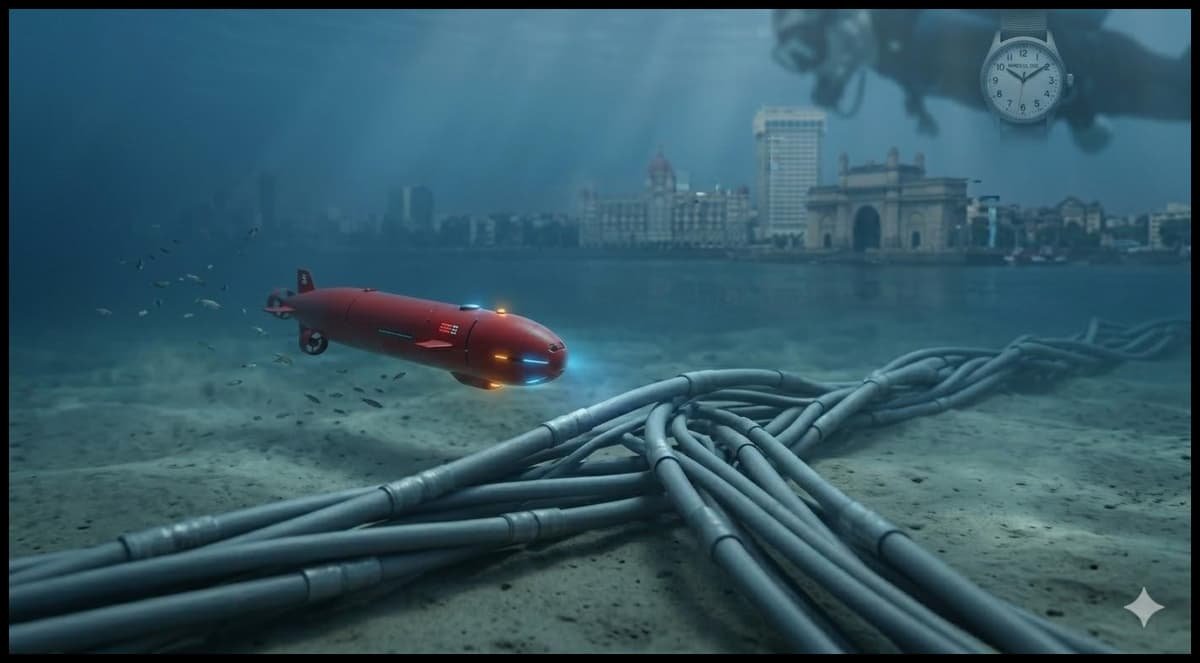
The battlefield has also moved deep underwater. Submarine drones, which navigate by scanning the ocean floor rather than relying on easily jammed GPS, are being deployed to hover menacingly over underwater internet cables and energy pipelines. This holds the region’s critical infrastructure hostage.
The Clash of Strategies: Precision vs. Saturation
This conflict highlights two completely different approaches to modern warfare, pitting incredibly expensive, centralized artificial intelligence against highly distributed, incredibly cheap swarms. This is not just a tactical divergence; it is a fundamental economic clash.
The Precision Strategy: US and Allied Forces
Allied forces are relying on advanced artificial intelligence to process vast amounts of data in seconds, seeking to win the war of information dominance. In previous eras, finding enemy targets took thousands of intelligence officers’ weeks of work. In early March, an allied AI system aggregated low-earth orbit satellite photos, hacked traffic cameras, and intercepted mobile phone metadata to locate 300 hidden mobile missile launchers in just a matter of minutes. This “Decision-Cycle Compression” allows for incredibly fast, surgical strikes that decapitate leadership and degrade launch sites before they can fire.
However, this hyper-advanced strategy possesses a glaring Achilles’ heel: its fragility. This doctrine relies on multi-million- dollar interceptor missiles and a highly complex, global supply chain of advanced semiconductors. The computing power required to run these targeting algorithms and guide these weapons cannot be easily replaced if a specialized microchip factory goes offline. The precision strategy is immensely powerful, but it is financially exhausting and structurally brittle.
The Asymmetric Strategy: Iran and Proxy Forces
Conversely, proxy forces have embraced the democratization of destruction, relying on overwhelming numbers, decentralized manufacturing, and cheap technology. This is the “Ferrari vs. Bicycle” dilemma. While a US defence missile costs over $10 million, an attacking drone costs roughly $35,000. Recently, attackers launched a coordinated swarm of 150 cheap drones that talked to each other in the air, utilizing basic “cognitive swarming” software to autonomously divide up targets and overwhelm advanced air defence radars.
What makes this asymmetric strategy particularly resilient is its “open-source” nature. These swarms do not rely on rare, military- grade components. They are built using commercial off-the-shelf parts—smartphone processors, hobbyist GPS modules, and 3D- printed fiberglass bodies. Because the manufacturing is decentralized across dozens of hidden workshops, traditional military strikes and economic sanctions struggle to halt production. This strategy actively attempts to bankrupt wealthier nations, forcing them to spend millions to shoot down cheap plastics and basic electronics, turning the economic strength of the superpower against itself.
The Global Impact: The India Vector
For countries like India, this technological war in West Asia is causing immediate domestic crises.
Because India imports 88% of its crude oil and much of its cooking gas through the Hormuz chokepoint, the high-tech blockade has caused immediate spikes in local fuel prices and restaurant costs. Furthermore, delayed shipments of farming fertilizers threaten upcoming agricultural season, turning a distant tech war into a local food security issue.
At the same time, 99% of global internet traffic travels through thin fibre-optic cables on the ocean floor, right through the conflict zone. When a recent underwater drone strike damaged a data relay in the Red Sea, stock market computers in Mumbai experienced a fraction-of-a-second delay. That tiny lag caused an estimated $40 million in automated trading losses in a single hour.
The Future: Automated Escalation
This conflict is a preview of how wars will be fought for the rest of the 21st century. We are moving toward three dangerous new realities.
First, as hypersonic missiles and drone swarms move faster than human reflexes, militaries are handing the authority to fire over to AI. Paul Scharre, a defence analyst who helped draft the Pentagon’s first policies on autonomous weapons, refers to this rapidly approaching threshold as the “battlefield singularity“—a tipping point where the sheer speed and complexity of combat outstrip human cognitive limits. This creates the terrifying risk of “Flash Conflicts”—catastrophic wars that start by accident because an algorithm misread a fake radar signal.
Second, with persistent AI satellite surveillance and thermal imaging, physical camouflage is dead. Everything is visible 24/7. Future survival will depend entirely on using hackers to project thousands of fake digital targets onto enemy screens to hide the one real asset.
Finally, because our banks, power grids, and smartphones run on the same data cables being targeted by the military, the battlefield is no longer contained to a desert. A strategic strike against a cloud server in the Middle East can instantly shut down a digital payment app in New Delhi.
Conclusion: Redefining Deterrence
The era of conventional military dominance has officially ended. The “Silicon Battlefield” has definitively proven that a nation’s power is no longer just about the explosive yield of its weapons, but the sophistication of the computer code that guides them and the resilience of the internet networks that sustain them. In this new reality, a sovereign state’s physical borders are no longer its only— or even its most important—line of defence.
To survive the 21st century, the concept of international deterrence needs be entirely redefined. True national security now requires protecting the invisible domains of our modern world: the hyperscale data centres, the crowded electromagnetic spectrum, and the fragile undersea cables that keep the global economy breathing.
Most importantly, as we rush to build faster algorithms and more autonomous swarms, we must ensure that our frameworks for human diplomacy do not get left behind. The ultimate challenge of the Software-Defined War is not just learning how to fight at the speed of light but learning how to negotiate and de-escalate before an automated machine makes a final, irreversible decision on behalf of humanity.
(Views expressed by the author are personal)


