
In a major step towards empowering the shallow water capabilities of the nation, the Indian Navy has formally incorporated Arnala, the first in a series of eight Anti-Submarine Warfare Shallow Water Crafts (ASW SWCs). The vessel was received by the Navy on the 8th of May and is set to strengthen its maritime posturing and indigenous defense capabilities. As the first ASW SWC, Arnala was designed and manufactured domestically, with 80% of the work done by firms like Garden Reach Shipbuilders and Engineers Ltd. (GRSE), Kolkata. It was finally delivered to the Indian Navy at the Larsen & Toubro (L&T) Shipyard, Kattupalli, under a Public-Private Partnership (PPP).
Arnala also exemplifies a successful collaboration of the public and private defense manufacturing, which is in line with the government’s latest Whole-of-Nation Approach, which was highlighted during the second edition of the Future Warfare Course (FWC 2.0). The vessel also symbolizes India’s growing prowess in indigenous naval shipbuilding. This also aligns with the national “Aatmanirbhar Bharat” initiative that aims to empower the nation’s indigenous manufacturing capabilities, especially in the defense manufacturing sector.
India has already reaped the benefits of this initiative in the form of NAMIS anti-tank weapon platform, advanced towed artillery gun systems, and the successful development of silicon carbide and GaN HEMT MMIC technology. Thus, the ASW SWC project, helmed by indigenous shipbuilders like GRSE and L&T Defence, is emblematic of India’s commitment to bolstering maritime readiness through domestically produced platforms.
Arnala – A Tribute to India’s Maritime Legacy
The vessel, aptly named “Arnala,” draws inspiration from the historic Arnala Fort, which is located off the coast of Vasai, Maharashtra. It pays homage to the nation’s rich maritime heritage and highlights the strategic foresight in commemorating pivotal historical landmarks through naval assets.
Arnala is also constructed under the strict guidelines of the Indian Register of Shipping (IRS). The vessel is 77 meters long and is currently the largest Indian Naval warship propelled by a Diesel Engine-Waterjet combination. It has been developed to operate effectively in coastal zones and shallow waters, where agility, speed, and low acoustic signatures are critical for mission success, especially to counter submarine warfare.
Boosting The Nation’s Coastal and Underwater Warfare Capabilities
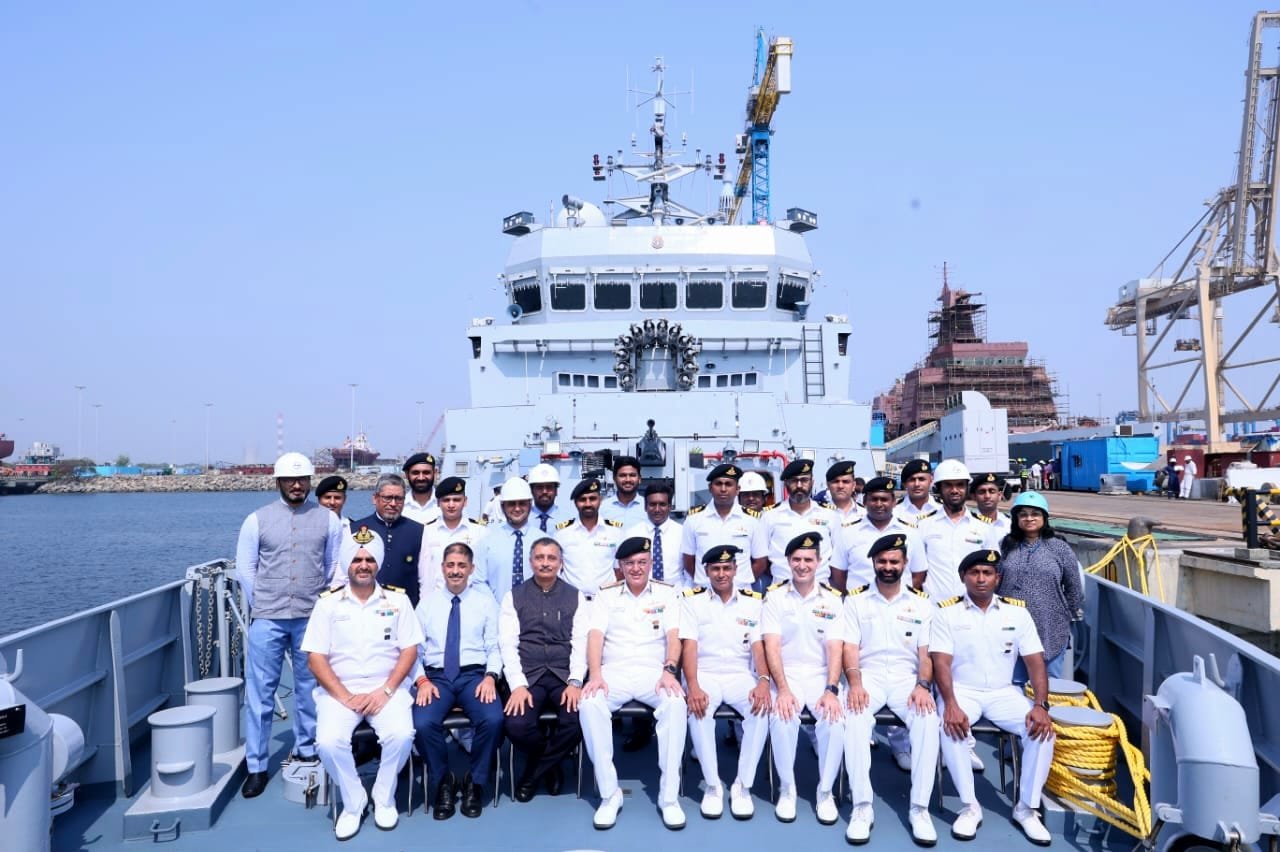
Designed for multifaceted roles, Arnala is capable of handling several shallow water missions, such as Search and Rescue (SAR) missions, Low Intensity Maritime Operations (LIMO), and high-precision mine laying. Such capabilities make it a critical asset in India’s coastal defense arsenal and help the Navy’s anti-submarine warfare (ASW) posture.
Arnala is also equipped with some of the advanced maritime defense platforms, such as:
- Hull-Mounted Sonar (HMS): The vessel incorporates the Abhay system, an advanced active-cum-passive integrated sonar system which is designed and developed by NPOL, DRDO, and manufactured by BEL
- Towed Low-Frequency Variable-Depth Sonar (LFVDS): It also utilizes a towed LFVDS system, which is being developed indigenously by a partnership between CFF Fluid Control Ltd. and German Atlas Elektronik.
Such advanced sonar systems allow the vessel to detect threats in real-time, thus helping with tactical coordination and joint operations. Furthermore, its ASW capabilities are also tailored for coastal waters, where conventional anti-submarine platforms often face operational limitations due to restricted maneuverability and shallow depth challenges.
What Does The Future Hold?
The delivery of Arnala is only the start. There are seven more ASW SWCs in production that will further bolster the overall maritime capabilities of the nation and allow it to maintain regional security while safeguarding its interests in a rapidly evolving geopolitical landscape. The induction of these vessels will also ensure that the country maintains a technologically advanced and combat-ready coastal defense architecture, capable of countering both conventional and asymmetrical threats.


