
In an exclusive interview with Kiran Raju, Founder and CEO of Indrajaal, Life of Soldiers explores how indigenous counter-UAS innovation is reshaping India’s air defence preparedness.
LoS: Indrajaal’s recent ₹100-crore contract from the Ministry of Defence is being seen as a watershed moment for indigenous counter-UAS capability. From your perspective, what strategic gap in India’s air defence architecture does this deployment decisively address?
KR: What this deployment decisively closes is the gap between high-end air defence and low-end aerial coercion. India has robust capabilities against fighters, missiles, and ballistic threats.
But drones operate below that threshold – low altitude, low signature, and often below the psychological radar until damage is already done. We’ve seen this gap exploited repeatedly, whether it’s cross-border drone drops, surveillance of naval facilities, or sabotage attempts against infrastructure. Indrajaal secures the airspace closest to the asset, where
reaction windows are measured in seconds and ambiguity is highest. It turns what was once a reactive, manpower-heavy problem into a persistent, autonomous layer of defence. It brings continuous, autonomous protection to bases, ports, and infrastructure that were previously exposed to these kinds of threats.
LoS: Modern battlefields from Ukraine to the Middle East, have demonstrated how low-cost drones can impose disproportionate tactical and psychological effects. How does Indrajaal’s approach to counter-UAS reflect the evolving nature of asymmetric aerial threats?
KR: Ukraine, Gaza, and the Red Sea have taught us the same lesson: economics and cognition matter as much as kinetics. You cannot afford to burn high-value interceptors on disposable drones, and you cannot expect human operators to stay ahead of swarms designed to exhaust attention. In other words, you cannot afford to respond to a ₹50,000 drone with a ₹5 crore interceptor, and you cannot rely on manual decision-making when drones arrive in waves. Indrajaal is built around that reality.
Indrajaal is built around proportionate response and psychological resilience. Most engagements never reach a hard kill. Through early detection, attribution, and soft denial, threats are neutralised quietly and repeatedly. The system is designed to remain calm under saturation, denying the adversary both physical impact and psychological leverage.
LoS: Indrajaal has often been described as a ‘system-of-systems’ rather than a single solution. Could you explain how this layered philosophy enhances survivability and decision-making for commanders on the ground?
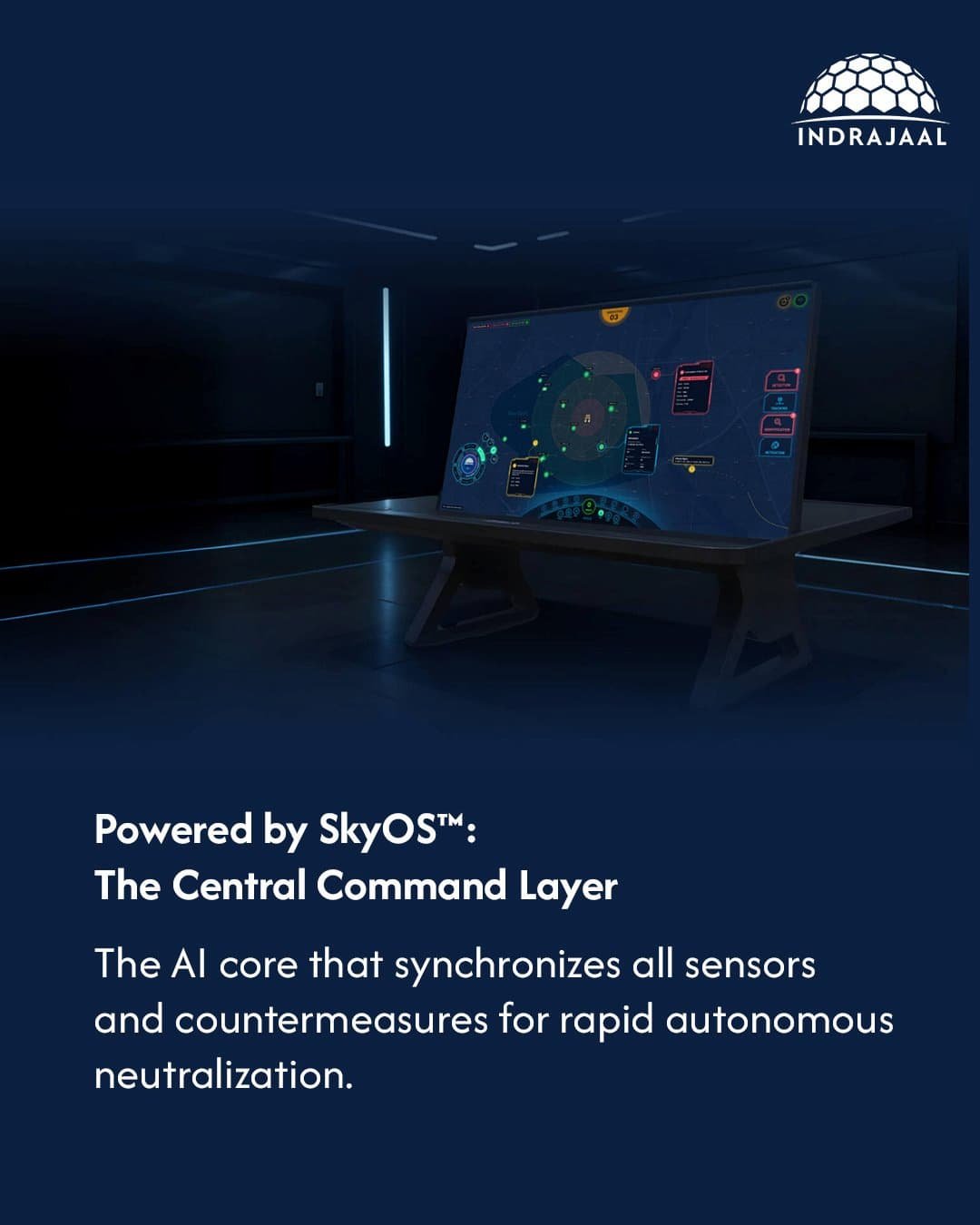
KR:Indrajaal is not a product – it is a defensive ecosystem. Radars, RF sensors, cyber tools, jammers, interceptor drones, and command software operate as a single adaptive system under SkyOS TM , our AI-driven decision layer.
This architecture eliminates single points of failure. And this works for both detection and mitigation. If radar is denied while detecting, then we can switch to electro-optics, for instance. During mitigation, if cyber takeover doesn’t work, then soft denial (such as spoofing) takes over. If soft denial doesn’t work, then the system opts for soft kill. The final option is hard kill. This ensures optimisation of resources.. For commanders, this matters
enormously. Instead of managing too many sensors and weapons, they manage intent and outcomes. The system filters complexity and presents decisions already weighted, prioritised, and, where authorised, executed.

LoS: Winning a major MoD contract is as much about trust as it is about technology. What were the key operational and doctrinal expectations from the Indian Armed Forces that shaped Indrajaal’s final configuration?
The armed forces were very clear about three things. Reliability in contested environments, minimal human workload, and doctrinal alignment with how Indian forces actually operate.
Indrajaal had to work in dense electromagnetic environments, near civilian airspace, and under rules of engagement that favour restraint. The final configuration reflects extensive feedback from users. It is not a lab system. It is something operators can trust at three in the morning during a real incident. That trust only comes from sustained user feedback, iteration, and operational humility.
LoS: India has traditionally relied on imported air defence solutions for critical capabilities. How significant is this project in signalling a shift towards confidence in home-grown, private-sector defence innovators?
KR: This contract signals a structural shift, not a symbolic one. A private Indian company is being entrusted with the protection of naval ports and strategic bases, assets where failure is not an option. That confidence is earned through capability, supportability, and roadmap
credibility. Indigenous innovation is no longer being evaluated merely on cost or substitution value, but on operational relevance. This is how mature defence ecosystems behave, and India is clearly entering that phase.
LoS: From an OSINT standpoint, adversaries are rapidly adapting using swarms, GPS-denied navigation, and AI-assisted autonomy. How future-proof is Indrajaal against these emerging drone doctrines over the next decade?
KR:We assume adaptation as a given. Any system that assumes a static adversary is already obsolete. Swarms, GPS-denied navigation, and autonomous behaviours are not future threats – they are present realities. Indrajaal is software-defined at its core. Sensors and effectors will evolve, but the real strength lies in SkyOS TM’s ability to learn, adapt, and integrate new countermeasures without rebuilding the system. The objective is not to defeat today’s drone, but to remain relevant against unknown drones five and ten
years from now.
LoS: Counter-UAS systems must operate in complex environments, civilian airspace, border areas, and dense electromagnetic spectra. How does Indrajaal balance hard-kill, soft-kill, and non-kinetic options without escalating unintended consequences?
KR:Escalation control is central to our design philosophy – it is foundational. Every engagement begins with identification and intent assessment. Soft-kill and cyber measures are preferred because they neutralise threats without debris, collateral damage, or escalation.
Hard kill options like interceptor drones are used only when necessary, and
even then in a controlled manner. This balance allows Indrajaal to operate safely near civilian areas and sensitive borders without creating new risks while solving the original
problem. In modern conflict, restraint is often a strategic advantage.
LoS: Beyond this contract, how do you see Indrajaal contributing to India’s broader defence posture, particularly in protecting critical infrastructure, forward bases, and high-value national assets?
KR: This contract is an important step, but it is not the end goal. The same architecture can protect airports, power plants, refineries, space facilities, forward bases, and mobile formations.
As drones become tools of surveillance, sabotage, and coercion, counter-UAS will become foundational infrastructure, much like perimeter security or cyber defence. Indrajaal is being built with that national responsibility in mind-scalable, persistent, and deeply integrated into India’s defensive posture.
LoS: Finally, for young engineers and defence entrepreneurs watching this milestone, what lessons does Indrajaal’s journey offer about building credible, combat-relevant technology within India’s defence ecosystem?
KR:The biggest lesson is that credibility is earned, not claimed. We spent years working quietly, testing in harsh conditions, and listening to users who challenged our assumptions. In defence, demos and slides mean very little. What matters is whether your system works when it counts. Build for the user, accept long timelines, and stay grounded in operational reality. If you do that consistently, trust follows.


