
The Indian Army is among the oldest professional armies in the world. Its lineage stretches back centuries, shaped by colonial campaigns, two World Wars, the trauma of Partition, and the steady consolidation of a young republic. Since Independence, the Army has fought multiple wars, countered externally sponsored terrorism, and remained engaged in prolonged internal security operations. Unlike the 1962 setback, the Indian Army has emerged victorious in every major conflict since, often under difficult political, logistical, and technological constraints.
This record has not been achieved by chance. It rests on a culture of front-line leadership, where officers and junior leaders share the same risks as their teams. It rests on discipline, adaptability, and a clear understanding of the soldier’s role in war. These fundamentals remain relevant today. What has changed, and continues to change rapidly, is the character of the battlefield.
Recent conflicts such as Russia–Ukraine and Israel–Gaza have once again drawn global attention to warfare. Analysts, policymakers, and military professionals are studying these conflicts closely, and rightly so. They underscore the importance of adaptability, rapid decision-making, and the integration of technology with strategy. However, these conflicts are not textbook wars. Each is shaped by distinct political aims, geography, escalation thresholds, and external involvement. They offer lessons, not templates. Blindly copying solutions without understanding the context would be a mistake.
Closer home, ongoing kinetic operations against terrorism, including OP SINDOOR, underscore that the Indian Army continues to fight a very real, very present war. This is not abstract theory. It is a daily contest of intelligence, endurance, and will. These operations demonstrate the Army’s resilience and its strategic resolve to protect national security, even as threats continue to evolve.
Unfortunately, public discourse on warfare in India is not always informed. Some politicians and commentators, with a scant understanding of military affairs, often conflate platforms, capability, and hardware with strategy. Loose statements on the conduct of war, made without grasping the consequences, do little to strengthen national security. Sound bites do not win a war. It is won by coherent doctrine, trained manpower, and the disciplined application of force.
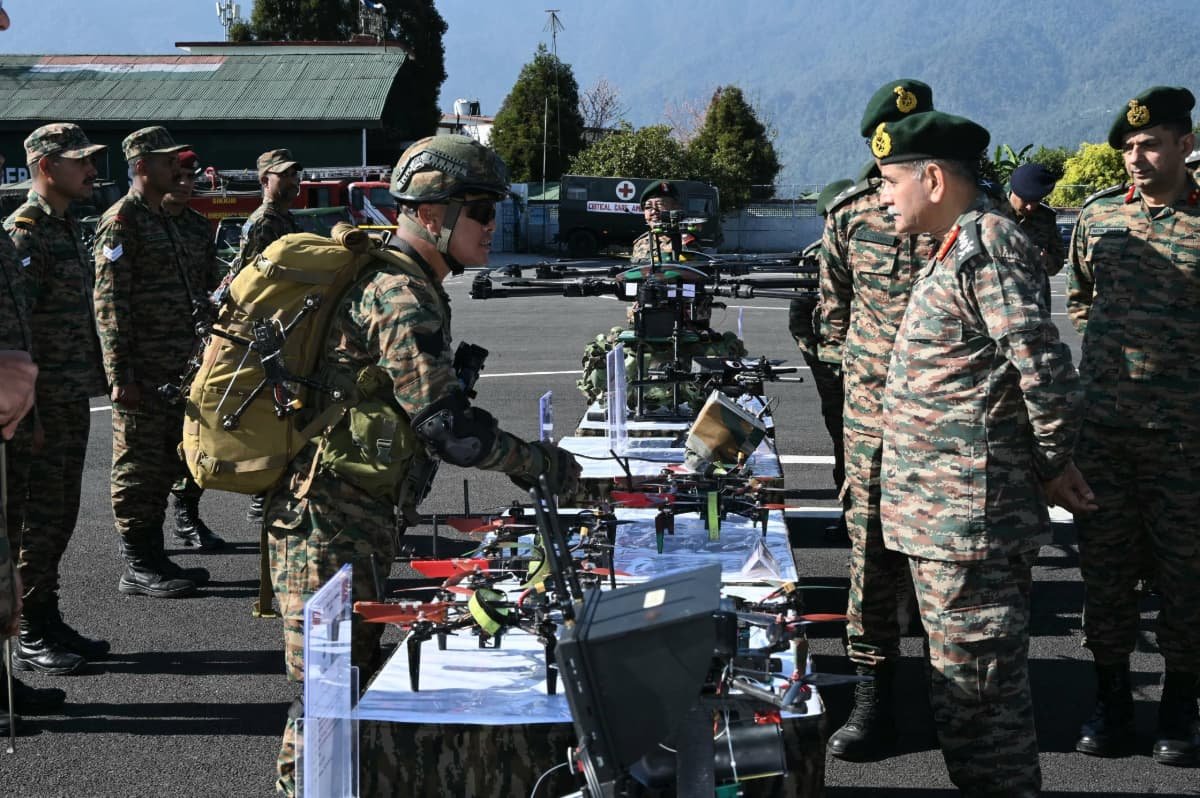
The modern battlefield is crowded with autonomous platforms. Drones, loitering munitions, unmanned ground vehicles, and maritime systems are no longer futuristic concepts. They are operational realities. From surveillance to strike roles, these systems have demonstrated their ability to inflict significant damage at relatively low cost. They compress decision timelines and challenge traditional notions of mass, manoeuvre, and even courage under fire.
This development raises serious questions. How do conventional forces counter such threats? How do they prevent inexpensive systems from neutralising expensive platforms? The answer does not lie in chasing every new gadget, but in integrated solutions. Millimetre-wave scanning radars, radar-controlled guns and missiles, electronic warfare, cyber security, and layered air defence systems must work together. Equally important is doctrinal clarity on how and when to employ these systems.
Technology, however, does not replace the tenets of warfare. It only changes the medium. Principles such as surprise, concentration of force, economy of effort, and unity of command remain as valid today as they were decades ago. The danger lies in assuming that technology alone can compensate for poor planning or weak leadership. Wars are still fought by human beings, even when machines play a larger role.
In all discussions about autonomous systems and networked warfare, the man on the ground must not be ignored. Infantry soldiers continue to hold ground, dominate terrain, and interact with civilian populations. Armoured crews, gunners, pilots, and sailors still operate platforms in uncertain, hostile environments. Morale, training, leadership, and trust within units remain decisive factors. No amount of automation can replace the judgment of a trained soldier under fire.
This is where doctrine becomes critical. The Indian Army must remain clear-headed about what it expects to fight and how it intends to fight. Doctrine is not a static document. It must evolve with threats, technology, and national objectives. Once doctrine is clear, organisational structures can be aligned to support it. Restructuring is not an admission of weakness. It is a recognition that old structures may not be optimal for new challenges.
Equipping the force must follow doctrine, not precede it. Acquisitions driven by headlines or inter-service rivalry weaken preparedness. What is required is a balanced force capable of operating across the spectrum of conflict, from sub-conventional operations to high-intensity conventional war under nuclear overhang. Where reliable, Indigenous capability must be encouraged. Where gaps exist, pragmatic solutions must be found without delay.
Training is the final, and perhaps most critical, link in this chain. Soldiers and leaders must train as they expect to fight. This includes exposure to electronic warfare environments, cyber disruptions, drone threats, and information warfare. At the same time, basic soldiering skills cannot be diluted. A soldier who cannot navigate, shoot, communicate, and endure hardship will not perform better because he carries advanced equipment.
There is also a need to prepare leaders mentally for ambiguity. Future wars are unlikely to follow neat phases or clear front lines. They will involve information operations, economic pressure, legal warfare, and influence campaigns alongside kinetic action. Officers must be educated to think beyond the tactical fight and understand the strategic consequences of their actions.
It is essential to note that proactive steps are already underway. The Indian Army is not standing still. Changes in force structure, an emphasis on jointness, improved surveillance and reconnaissance capabilities, and enhanced counter-drone measures are all indicators that an institution is aware of its challenges. These efforts may not always be visible to the public, nor should they be. Profound military transformation is rarely loud.
However, transformation is not a one-time event. It is a continuous process. It requires honest self-assessment, professional debate within the services, and political support that is informed rather than intrusive. Civil-military trust is essential. The armed forces must be given clear objectives and the freedom to advise on how best to achieve them.
The Indian Army has faced adversity before and adapted successfully. Its strength lies not only in its weapons, but in its ethos. As warfare changes, that ethos must guide transformation. Technology will continue to evolve. Threats will mutate. What must remain constant is clarity of purpose, professional competence, and the unwavering commitment to defend the nation.
Transformation, therefore, is not optional. It is necessary. And the Indian Army, grounded in experience yet open to change, is capable of meeting tomorrow’s challenges while safeguarding the values that have sustained it for generations.


